

Our Made by People series celebrates the individuals across our sites who bring our values to life: guided by care, forged by boldness, connected by trust, driven by precision and sparked by ideas. This month, we meet Oliver Harper, Graduate Engineer at OxDevice.
Approaching his first anniversary with the business, Oliver has already worked across Nitinol braiding, cardiovascular devices, stent design and manufacture, specialist packaging and process development.
It is a broad and technically demanding introduction to medical engineering. But spend any time speaking to Oliver and it quickly becomes clear that he would not want it any other way.
He is naturally curious. He likes understanding how things work, taking them apart and finding better ways to put them together. He is equally comfortable discussing medical robotics, rebuilding a motorbike or designing a solution to an everyday problem at home. For Oliver, engineering is not simply a career choice. It is how he sees the world.
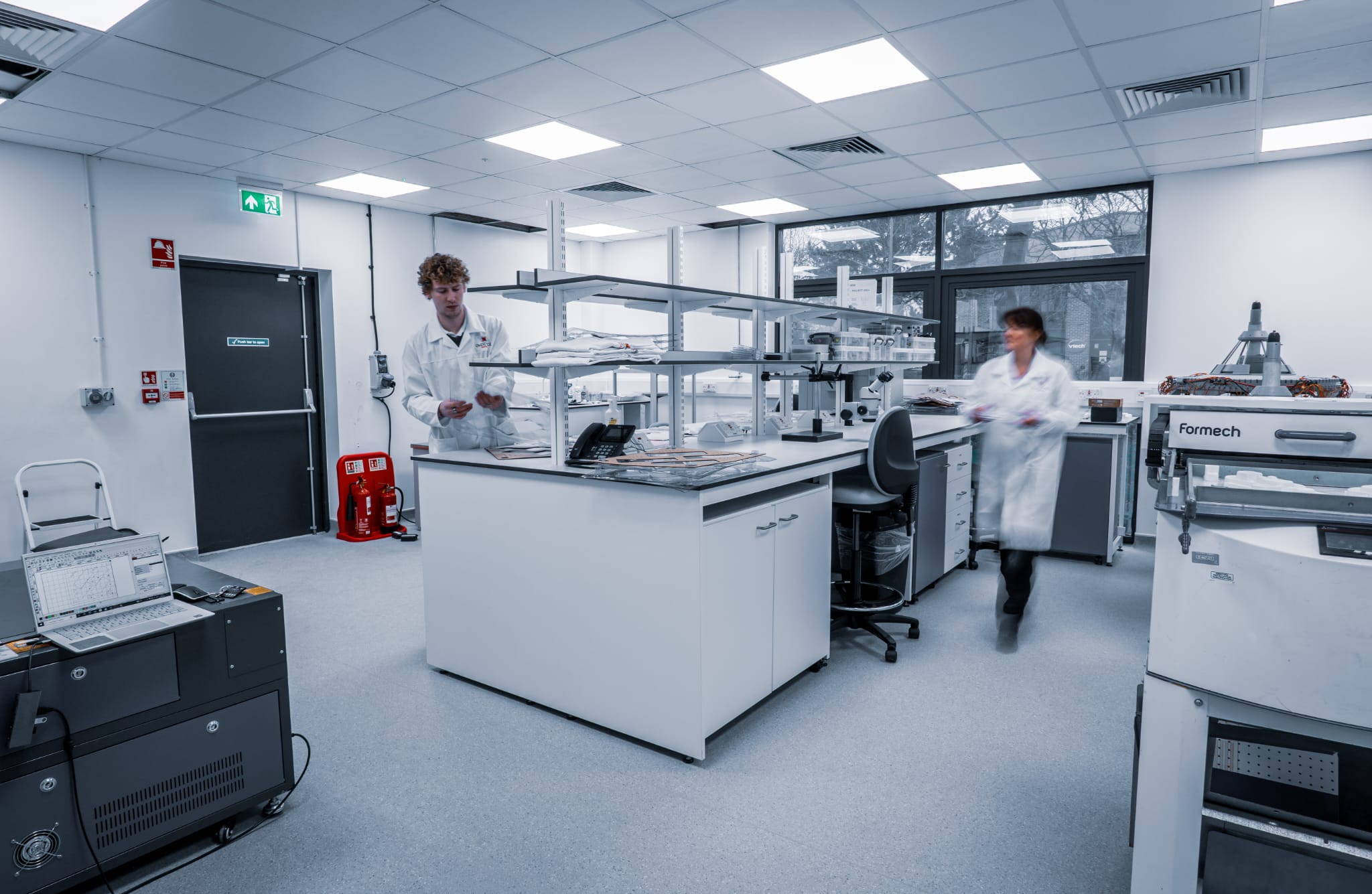
Finding the right combination
Oliver’s interest in healthcare began at home. Both of his parents work within the NHS, so medicine and its impact on people were always part of the environment in which he grew up. At the same time, he was drawn towards maths, physics, software and the practical satisfaction of building something himself.
Medicine interested him, but becoming a clinician did not. Medical engineering offered a way to bring those different interests together.
“Engineering in the medical-device world seemed like the coolest combination of the two. You can use engineering and really interesting technology to create devices that could genuinely help people.”
Oliver completed a four-year master’s degree at University College London, focused on biomedical engineering. His studies combined different areas of engineering, while his final thesis allowed him to explore one of the fields that continues to fascinate him: robotics.
Alongside university, he sought out practical experience wherever he could find it. He worked with start-ups developing neurovascular and ear, nose and throat imaging technologies, completed research involving computational fluid dynamics and spent time in Hong Kong working across research, microelectronics and engineering consultancy.
Although the environments varied, the direction remained consistent. Oliver wanted to use engineering within medicine.
Why OxDevice stood out
After graduating and returning from travelling, Oliver decided to focus his job search exclusively on medical devices. What attracted him to OxDevice was the opportunity to see more than one isolated part of the process.
Rather than working solely in research, design or manufacturing, he could contribute within a company that connects those disciplines, helping customers move from an early concept through development and into repeatable manufacture.
“OxDevice is special because it designs and manufactures. You get a full, holistic view of product development rather than seeing only one part of it.”
The people also made an immediate impression. Oliver remembers meeting the team during the interview process and recognising an environment in which people genuinely enjoyed working together. Then he saw OxDevice’s automated braiding technology.
Having already explored robotics, software, 3D printing and the automation of manufacturing processes, Oliver immediately saw a connection with the work he wanted to pursue.
“When I saw the braiding machine, I thought it was amazing. It was exactly the kind of thing I wanted to work on.”
That combination,meaningful medical-device development, practical manufacturing capability, automation and a supportive team, made OxDevice feel like the right place to begin his career.

Learning the braid
Braiding has become one of the central areas of Oliver’s work. The principle can be imagined as a maypole dance. Individual strands move around one another in a controlled sequence, passing over and underneath to create a repeatable braided structure.
In medical devices, those strands may be extremely fine Nitinol wires, brought together to create complex geometries for cardiovascular technologies and other specialist applications.
Traditionally, intricate braids could be produced manually. But manual work is slow, difficult to repeat and vulnerable to human error. A single mistake halfway through can mean undoing a significant amount of work and beginning again.
OxDevice’s technology uses mechanical movement and software control to automate the process while retaining the ability to produce customised patterns. For Oliver, it represents exactly what good engineering should do: take a skilled but demanding process, understand it properly and create a more consistent and efficient way to perform it.
“With manual braiding, you can get halfway through and realise something is wrong. Because the automated process is controlled through software, it reduces those errors, cuts processing time and allows people to focus on other meaningful work.”
The technology has allowed Oliver to combine his interests in automation, software and medical-device manufacturing while developing a detailed understanding of Nitinol and its potential.
A baptism by fire
Joining OxDevice also brought a steep learning curve. Oliver arrived with a strong academic background, but professional medical-device development introduced new tools, systems and responsibilities.
One early challenge was developing his CAD capability using SOLIDWORKS. Although he had previous design experience, it was not the main platform used during his university course. Support from Ryan Simmons, Head of CAD and Design, helped him build his confidence and technical fluency.
The quality requirements surrounding medical devices presented another significant area of learning. Work instructions, process documentation, equipment records and validated procedures all have to connect. Nothing can simply exist inside an engineer’s head; the process must be understood, controlled and repeatable.
Rather than finding those disciplines restrictive, Oliver has come to understand how they turn a successful idea into something that can be manufactured reliably. That became particularly clear during a project involving a device designed to modify blood flow within the cardiovascular system.
Oliver was able to observe the full journey: early brainstorming, CAD development, tooling, process design, tolerance control, quality documentation and low-volume manufacturing.
“It was a complete baptism by fire, and I absolutely loved it. You could see how the original idea moved into CAD, how the tooling was created and how everything fitted into the quality system.”
Other assignments have shown him that even apparently secondary elements can demand considerable engineering thought.
While developing packaging for delicate medical probes, for example, Oliver had to ensure that the components remained protected if the pack was inverted, dropped or subjected to the demands of transportation. The solution required repeated design iterations, different retaining features, material changes and practical testing.
The work reinforced a fundamental lesson: successful medical-device engineering includes everything required to protect the product and ensure it performs as intended—not only the device itself.
Learning by asking why
Oliver credits much of his progress to the accessibility of the people around him. Working alongside experienced engineers such as Nicolas Chan has allowed him to ask not only what decision has been made, but why.
Why has a particular catheter size been selected? Why does a stent require a certain geometry? Why has a process or quality document been changed? The answers help him see the relationship between engineering choices, manufacturing requirements and the eventual clinical application.
“The great thing about OxDevice is that when there’s a design choice or a change to the documentation, there’s always someone you can go to and ask why.”
For a graduate engineer, that open communication is invaluable. It means Oliver is not simply completing individual tasks. He is steadily building a picture of the complete development process and understanding the reasoning behind it.
The moment it works
There is, however, one part of engineering that no amount of documentation can replace: the moment a device works. Oliver remembers reaching the end of a stent project and deploying the finished device from its catheter. As it emerged, the stent expanded exactly as intended.
He and a colleague looked at one another and celebrated. It was a relatively brief moment after weeks of development, but it captured everything Oliver enjoys about the work: a difficult problem, a physical creation and the possibility of improving someone’s life.
“Seeing your hard work pay off is a huge motivator. Then that feeling is doubled by the fact that what you’ve created could potentially save someone’s life.”
That sense of purpose is what separates medical engineering from other technically interesting career paths Oliver might have followed. He enjoys the act of creating. But knowing what that creation could mean to a patient gives every tolerance, test and iteration greater significance.
Engineering beyond the working day
Oliver’s instinct to design and build does not disappear when he leaves OxDevice. He has stripped down and rebuilt a motorbike and hopes to take on a similar project with a car. Around the house, he finds himself identifying small problems and imagining engineered solutions, whether that means designing a shelf, testing how much weight it could support or considering how it might be manufactured.
During university, he also helped establish a start-up developing 3D-printed neurosurgical skull models. The models were designed to offer surgeons an accessible training alternative where traditional options could be costly or ethically complex. He continues to revisit and refine the design.
“Engineering and designing solutions are just things I’ve always wanted to do. It isn’t something I leave at the door.”
It is this instinctive curiosity that makes Oliver particularly well suited to an environment where customers may arrive with an unsolved problem rather than a finished specification.
Looking towards what comes next
Oliver is still at the beginning of his career, and he is deliberately keeping an open mind about where it might lead.
Medical robotics remains a major interest. His master’s project involved designing and manufacturing a voice-controlled robotic system intended to help people with quadriplegia adjust the position of media devices independently.
The project brought together mechanical engineering, electronics, software and machine learning,the combination of disciplines that makes robotics so compelling to him.
“Robotics combines almost every part of engineering. Electronics, software and mechanical design all come together, and the potential of what you can create with it is incredible.”
At OxDevice, the next stage of his development includes training on a new femtosecond laser used for precision Nitinol processing. Building that capability will allow him to become more closely involved in how devices are both designed and manufactured.
Further ahead, his ambitions could take him towards medical or surgical robotics, greater ownership of device-development programmes or perhaps even establishing a medical-device company of his own.
For now, the opportunity is to keep learning, keep asking questions and continue developing devices that turn difficult clinical challenges into practical engineering solutions.
Oliver may not yet know exactly where that path will take him. But for someone motivated by building, learning and making a meaningful difference, OxDevice is giving him the opportunity to explore just how far it could go.