

This year’s International Women’s Day theme, Give To Gain, is a powerful reminder that when we share knowledge, opportunity and support, everyone benefits.
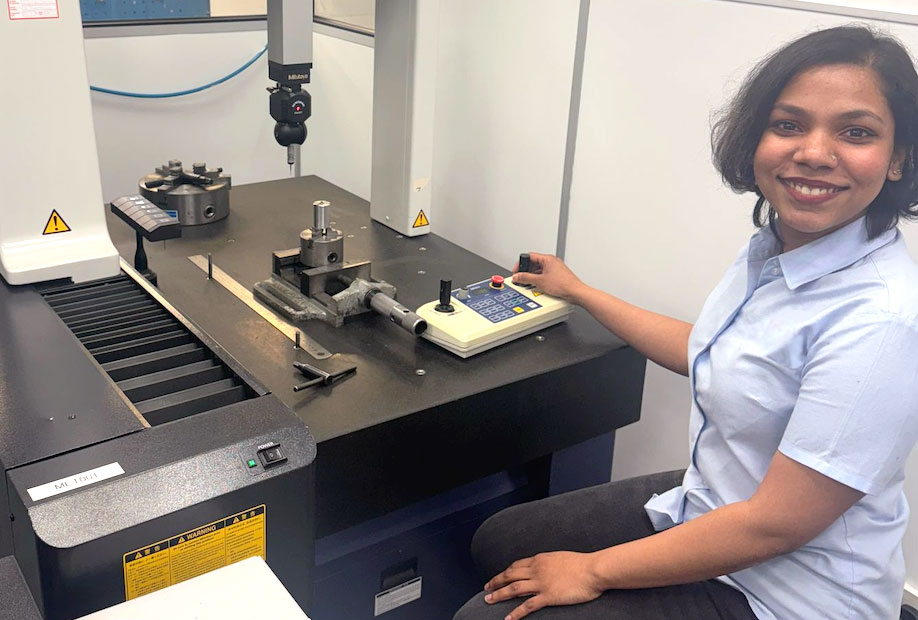
For Mufeeda Koyilot, Biomedical Engineer at Kirkstall Precision Engineering, that idea isn’t just a theme. It’s the story of her career.
From early curiosity in India to contributing to precision medical manufacturing in the UK, her journey has been shaped by mentorship, collaboration and the belief that when we give insight and courage to others, we gain far more than we expect.
Curiosity before career
As a child, Mufeeda was equally fascinated by maths and biology. While others were captivated by what medical devices did, she was drawn to how they were built. “I didn’t just want to use the device. I wanted to understand who created it, how it worked, and how it could be improved.”
At some point, she realised something transformative: she didn’t have to be the doctor using the tools. She could help create them. That decision set her on a path from Model Engineering College in India to a Master’s degree at Newcastle University, a journey shaped not by isolation, but by people who gave their time, belief and honest feedback.
“In biomedical engineering,” she explains, “nothing meaningful happens in isolation. Innovation happens when researchers, clinicians, engineers and regulators share ideas.” Give to Gain, for her, isn’t abstract. It’s collaborative science in action.
The power of being allowed to choose
Not every career decision begins with certainty. When Mufeeda chose biomedical engineering, it wasn’t a familiar path for her family. But what her parents gave her was something even more powerful than direction, they gave her freedom. “They weren’t entirely sure at first,” she says, “but they let me choose.”
That freedom became fuel. Teachers and mentors pushed her to publish research, present at conferences and think bigger than she initially believed possible. Her sister became her emotional anchor, the steady reminder of who she was on days confidence wavered.
Later, a pivotal professional decision reinforced the theme once again. Offered a role at a large multinational, she instead chose Kirkstall Precision Engineering after conversations with Adam Thornton and Clare Firth.
“I chose the smaller, family-run environment. That decision changed everything.” At Kirkstall, she isn’t simply following established systems, she’s contributing to building them. She sees ideas move from drawings to implants, instruments and various products. She sees how decisions on the shop floor ultimately affect patients. “Every person who supported me gave me belief. And that belief became courage.”
Taking the risk
For young women and girls considering careers in STEM, especially in underrepresented fields, Mufeeda’s advice is simple: Take the risk. “I’ve experienced imposter syndrome more times than I can count,” she admits. “But growth doesn’t happen inside a comfort zone.”
There were rooms where she was one of the only women. Ten years ago, she struggled to name female leaders in her domain. Today, she sees more women shaping boards, leadership teams and policy. “That shift happened because women before us stepped forward anyway.”
Her message ties directly back to Give to Gain: “Every time you give knowledge, encouragement or support to someone else, you gain perspective, confidence and new opportunities in return.”
Lift others, and the field moves forward with you. STEM, she emphasises, isn’t about being the loudest voice in the room. It’s about curiosity, resilience and contribution. “If you give your time, your ideas and your courage, you’ll gain far more than a career. You’ll gain impact.”
Giving time. Gaining leadership.
Throughout her career, Mufeeda has mentored junior engineers, guiding them through regulatory thinking, documentation discipline and the pressure of early-career deadlines. At the time, she saw it as simply sharing experience.
Then a colleague told her: “You made this feel possible and easy for me. I finally feel confident tackling these projects on my own.” That moment stayed with her.
She has also volunteered extensively within communities supporting women and LGBTQI+ individuals in STEM, hosting workshops, hackathons and peer learning sessions while juggling a full-time engineering syllabus. There were sleepless nights. But there was also growth.
“What did I gain? Leadership. Budgeting skills. Confidence pitching to sponsors. Decision-making skills. But more importantly, I discovered versions of myself I didn’t know existed.” “When you give your time, you don’t lose it. You expand.”
Collaboration at the core
At Kirkstall Precision Engineering, teamwork isn’t optional, it’s structural. Quality, regulatory, production, sales and engineering all depend on one another. Cross-functional collaboration ensures safer products and stronger outcomes for patients.
“People assume quality and regulatory are just paperwork. It’s not,” she says. “You must understand the device, the materials, the design, the manufacturing flow and the risk to the patient. Without deep product understanding, regulatory submissions become reactive instead of strategic.”
Early collaboration prevents late-stage firefighting. Open dialogue reduces fear. Documentation protects patients. For women entering the field, that culture matters. When knowledge is shared openly, visibility increases. Confidence grows. Ownership becomes possible. “When we give transparency, mentorship and technical exposure, we gain talented engineers and safer devices.”
Inclusion, she notes, isn’t a box to tick; it’s a performance advantage. It improves problem-solving. Different perspectives catch gaps earlier. And in medtech, catching gaps early can mean everything.
The future is personal
When asked what excites her most about the future of medtech, her answer is immediate. “Everything.” From working on 3D bioprinting cartilage to watching cells multiply under a microscope in bioink she prepared, she has seen science that once felt surreal become tangible reality. Her experience spanning academic research and highly regulated implantable medical manufacturing allows her to approach regulation not as a checklist, but as a strategic link between innovation and real-world patient outcomes.
“I’ve seen hydrogel scaffolds under scanning electron microscopy and realised how tangible innovation can become. Another rewarding moment was watching real-time EEG signals appear from sensors we had built. Seeing biological signals translate into live data on a screen felt like watching engineering and neuroscience speaking the same language. Moments like that reminded me exactly why I chose this field.” Now add AI in diagnostics, smart implants, personalised medicine and organ-on-chip platforms accelerating research. Innovation pushes boundaries. Regulation protects people. “That tension is dynamic and necessary.”
And behind every implant, audit and submission? A patient. A family. “If I can give my expertise today, whether through mentoring, improving compliance systems or shaping smarter regulatory strategies, I help build a safer future. And maybe one day, a young girl reading about nanobots or smart implants will decide she wants to build them.”
That’s how we give. That’s how we gain.
International Women’s Day 2026 Give To Gain
At Kirkstall Precision Engineering, and across the Kaleidex Group, progress in medtech isn’t driven by individuals working alone. It’s driven by people willing to share knowledge, mentor others and step forward, even when they don’t feel fully ready.
Mufeeda’s story is a reminder that every act of support, every shared insight, every conversation that builds confidence contributes to something bigger. Because when we give belief, opportunity and expertise, we don’t diminish ourselves. We multiply impact and expand what’s possible.